The Influence Of Problem-Based Learning Model With Inquiry Approach To Learning Outcomes Of Geography In High School
DOI:
https://doi.org/10.58330/pr.v1i1.92Keywords:
Problem Based Learning, Inquiry, Learning Outcomes.Abstract
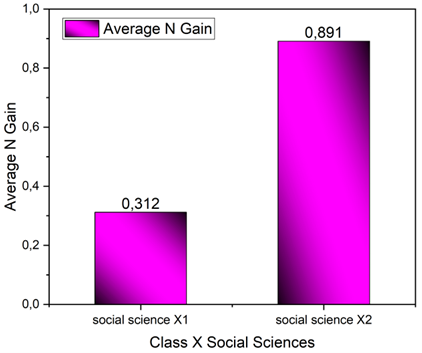
This study aims to determine the effect of a problem-based learning model with an inquiry approach to the geography learning outcomes of class X MA Darussalam Al-Kubro Moyot Islamic Boarding School Foundation, especially in the essential competencies of analyzing natural disaster mitigation and adaptation with geographical studies. The method used is descriptive quantitative. The results of the data analysis of student geography learning scores showed an increase in the average gain of the experimental class from 59.08 to 77.82, with an increase of 18.74. Although the control class also experienced an increase in score of 56.75 to 70.25 with an increase of 13.5, when compared to the experimental class, the increase in the average score of learning outcomes was higher than the increase in the control class. The difference in the increase in the score of the experimental class learning outcomes with the control is 7.57. So, the problem-based learning model with the inquiry approach significantly affects the student learning outcomes of MA Darussalam Al-Kubro Moyot. This is evidenced by the results of calculating the gain score statistic 0.4758 with a standard error of 0.02787 and a mean of 5%. The problem-based learning model with an inquiry approach can improve high school student learning outcomes. Using a problem-based learning model with an inquiry approach can develop character values of tolerance, democracy, communicativeness, self-confidence, and respect for achievement.
Downloads
References
Alam, T. G. M. R. (2019). Comparative analysis between pre-test/post-test model and post-test-only model in achieving the learning outcomes. Pakistan Journal of Ophthalmology, 35(1).
Albay, E. M. (2019). Analyzing the effects of the problem solving approach to the performance and attitude of first year university students. Social Sciences & Humanities Open, 1(1), 100006.
Aldayel, A. A., Alali, A. O., Altuwaim, A. A., Alhussain, H. A., Aljasser, K. A., Bin Abdulrahman, K. A., Alamri, M. O., & Almutairi, T. A. (2019). Problem-based learning: Medical students’ perception toward their educational environment at Al-Imam Mohammad Ibn Saud Islamic University. Advances in Medical Education and Practice, 95–104.
Aliman, M., & Astina, I. K. (2019). Improving Environmental Awareness of High School Students’ in Malang City through Earthcomm Learning in the Geography Class. International Journal of Instruction, 12(4), 79–94.
Ariyani, B., & Kristin, F. (2021). Model Pembelajaran Problem Based Learning untuk Meningkatkan Hasil Belajar IPS Siswa SD. Jurnal Imiah Pendidikan Dan Pembelajaran, 5(3), 353–361.
Chevalier, M., Giang, C., Piatti, A., & Mondada, F. (2020). Fostering computational thinking through educational robotics: A model for creative computational problem solving. International Journal of STEM Education, 7(1), 1–18.
Demiroz, F., & Haase, T. W. (2020). The concept of resilience: A bibliometric analysis of the emergency and disaster management literature. In Local Disaster Management (pp. 16–35). Routledge.
Evrim, U., & Dadli, G. (2020). The effect of problem-based learning on 7th-grade students’ environmental knowledge, attitudes, and reflective thinking skills in environmental education. Journal of Education in Science Environment and Health, 6(3), 177–192.
Felszeghy, S., Pasonen-Seppänen, S., Koskela, A., Nieminen, P., Härkönen, K., Paldanius, K., Gabbouj, S., Ketola, K., Hiltunen, M., & Lundin, M. (2019). Using online game-based platforms to improve student performance and engagement in histology teaching. BMC Medical Education, 19(1), 1–11.
Kardipah, S., & Wibawa, B. (2020). A Flipped-Blended Learning Model with Augmented Problem Based Learning to Enhance Students’ Computer Skills. TechTrends, 64(3), 507–513. https://doi.org/10.1007/s11528-020-00506-3
Kawuri, M. Y. R. T., Ishafit, I., & Fayanto, S. (2019). Efforts to improve the learning activity and learning outcomes of physics students with using a problem-based learning model. IJIS Edu: Indonesian Journal of Integrated Science Education, 1(2), 105–114.
Luoise, I. S. Y. (2019). The effect of problem based learning model on critical thinking skills in the context of chemical reaction rate. Journal of Education and Learning (EduLearn), 13(3), 395–401.
Munandar, A., Maryani, E., Rohmat, D., & Ruhimat, M. (2020). Establishing the Profesionalism of Geography Teacher through Authentic Assessment Field Study. International Journal of Instruction, 13(2), 797–818.
Nurlaily, V. A., Soegiyanto, H., & Usodo, B. (2019). Elementary School Teachers’ Obstacles in the Implementation of Problem-Based Learning Model in Mathematics Learning. Journal on Mathematics Education, 10(2), 229–238.
Permata, L. D., Kusmayadi, T. A., & Fitriana, L. (2018). Mathematical problem solving skills analysis about word problems of linear program using IDEAL problem solver. Journal of Physics: Conference Series, 1108(1), 012025.
Saputra, M. D., Joyoatmojo, S., Wardani, D. K., & Sangka, K. B. (2019). Developing critical-thinking skills through the collaboration of jigsaw model with problem-based learning model. International Journal of Instruction, 12(1), 1077–1094.
Serevina, V., Astra, I., & Sari, I. J. (2018). Development of E-Module Based on Problem Based Learning (PBL) on Heat and Temperature to Improve Student’s Science Process Skill. Turkish Online Journal of Educational Technology-TOJET, 17(3), 26–36.
Simamora, R. E., & Saragih, S. (2019). Improving Students’ Mathematical Problem Solving Ability and Self-Efficacy through Guided Discovery Learning in Local Culture Context. International Electronic Journal of Mathematics Education, 14(1), 61–72.
Stephan, M. (2020). Teacher-centered teaching in mathematics education. Encyclopedia of Mathematics Education, 836–840.
Sugiyono, D. (2018). Metode penelitian kuatintatif, kualitatif dan R & D/Sugiyono. Bandung: Alfabeta, 15(2010).
Supena, I., Darmuki, A., & Hariyadi, A. (2021). The Influence of 4C (Constructive, Critical, Creativity, Collaborative) Learning Model on Students’ Learning Outcomes. International Journal of Instruction, 14(3), 873–892.
Wang, A., Xiao, R., Zhang, C., Yuan, L., Lin, N., Yan, L., Wang, Y., Yu, J., Huang, Q., & Gan, P. (2022). Effectiveness of a combined problem-based learning and flipped classroom teaching method in ophthalmic clinical skill training. BMC Medical Education, 22(1), 1–10.
Zamora-Polo, F., Corrales-Serrano, M., Sánchez-Martín, J., & Espejo-Antúnez, L. (2019). Nonscientific university students training in general science using an active-learning merged pedagogy: Gamification in a flipped classroom. Education Sciences, 9(4), 297.
Downloads
Published
Issue
Section
License
Copyright (c) 2022 Moh. Zainuddin, Andrinata

This work is licensed under a Creative Commons Attribution-NonCommercial-ShareAlike 4.0 International License.