Student Satisfaction With Teaching Performance, Academic Administration Services, And Learning Facilities
DOI:
https://doi.org/10.58330/khidmatuna.v2i1.230Keywords:
Student Satisfaction, Teaching Performance of Lecturers, Academic Administration Services, Teaching FacilitiesAbstract
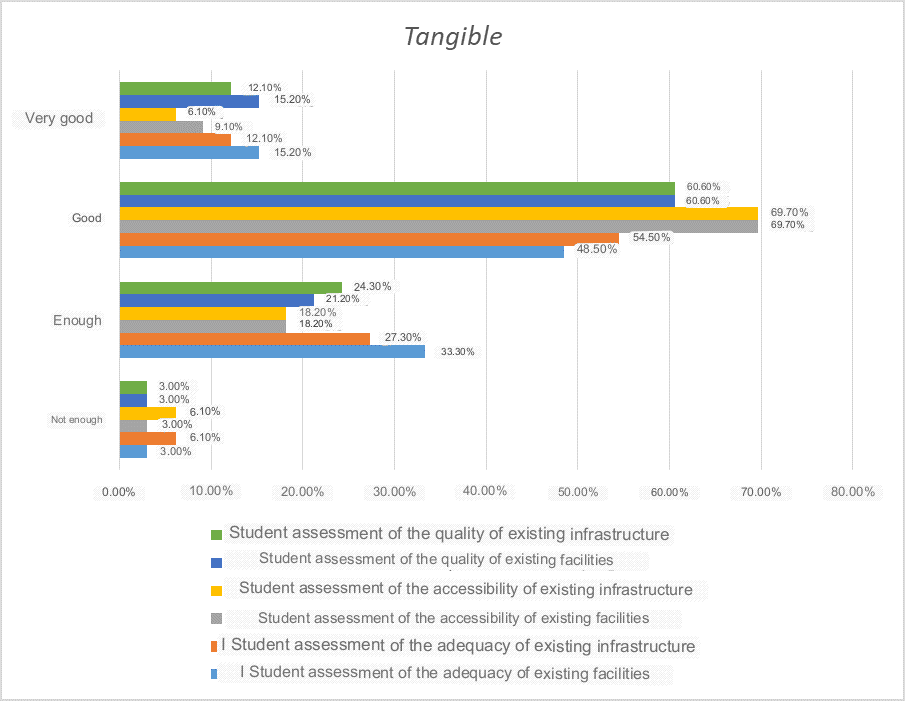
This journal aims to evaluate student satisfaction with the teaching performance of lecturers, academic administration services, and teaching facilities/infrastructure in a university. The method used was a survey with a questionnaire distributed to students at the university. The survey results showed that the majority of students were satisfied with the teaching performance of lecturers, academic administration services, and teaching facilities/infrastructure. However, there are still a small number of students who feel dissatisfied, especially with the teaching facilities/infrastructure. In terms of the teaching performance of lecturers, the majority of students feel satisfied and very satisfied with the willingness or concern of lecturers in helping them. While in the aspect of academic administration services, the majority of students feel satisfied and very satisfied with the willingness or concern of administrative staff in helping them. However, in the aspect of teaching facilities/infrastructure, there are still a small number of students who feel dissatisfied with the sufficiency, quality, and accessibility of the facilities and infrastructure available. From these survey results, it can be concluded that although the majority of students feel satisfied with the teaching performance of lecturers, academic administration services, and teaching facilities/infrastructure, there is still a need to improve the quality of teaching facilities/infrastructure to maximize student satisfaction.
References
Altinay, L., Song, H., Madanoglu, M., & Wang, X. L. (2019). The influence of customer-to-customer interactions on elderly consumers’ satisfaction and social well-being. International Journal of Hospitality Management, 78, 223–233. https://doi.org/10.1016/j.ijhm.2018.09.005
Andoh, R. P. K., Appiah, R., & Agyei, P. M. (2020). Postgraduate Distance Education in University of Cape Coast, Ghana: Students’ Perspectives. International Review of Research in Open and Distributed Learning, 21(2), 118–135. https://doi.org/10.19173/irrodl.v21i2.4589
Aprianto, W. N., Sir, I., & Amir, A. (2022). Practice of Audio-Visual Learning Media to Grow the Motivation of MI Kenongomulyo Students’ Learning. ETDC: Indonesian Journal of Research and Educational Review, 1(2), Article 2. https://doi.org/10.51574/ijrer.v1i2.271
Atika, A., Arifin, Z., & Jannana, N. S. (2021). Integrated School Management-Character Education Affirmation: A Case Study in Muhammadiyah Wirobrajan 3 Elementary School Yogyakarta. Al-Tanzim: Jurnal Manajemen Pendidikan Islam, 5(2), 15–26.
Bafadal, I., Juharyanto, J., Nurabadi, A., & Gunawan, I. (2018). Principal Leadership and its Relationship with Student Learning Achievements: A Regression Analysis. 3rd International Conference on Educational Management and Administration (CoEMA 2018), 156–158.
Bonner, P. J., Warren, S. R., & Jiang, Y. H. (2018). Voices From Urban Classrooms: Teachers’ Perceptions on Instructing Diverse Students and Using Culturally Responsive Teaching. Education and Urban Society, 50(8), 697–726. https://doi.org/10.1177/0013124517713820
Caskurlu, S., Maeda, Y., Richardson, J. C., & Lv, J. (2020). A meta-analysis addressing the relationship between teaching presence and students’ satisfaction and learning. Computers & Education, 157, 103966.
Chong, S. C., Falahat, M., & Lee, Y. S. (2020). Emotional Intelligence and Job Performance of Academicians in Malaysia. International Journal of Higher Education, 9(1), 69–80.
Dinh, L. P., & Nguyen, T. T. (2020). Pandemic, social distancing, and social work education: Students’ satisfaction with online education in Vietnam. Social Work Education, 39(8), 1074–1083. https://doi.org/10.1080/02615479.2020.1823365
Giray, G. (2021). An assessment of student satisfaction with e-learning: An empirical study with computer and software engineering undergraduate students in Turkey under pandemic conditions. Education and Information Technologies, 26(6), 6651–6673. https://doi.org/10.1007/s10639-021-10454-x
Kemal, I., Suryadi, & Rosyidi, U. (2019). Management of Lecturers Resource Development at Higher Education. International Journal of Higher Education, 8(5), 246–256.
Kotler, P. (2004). A three‐part plan for upgrading your marketing department for new challenges. Strategy & Leadership.
Lin, L., Huang, Z., Othman, B., & Luo, Y. (2020). Let’s make it better: An updated model interpreting international student satisfaction in China based on PLS-SEM approach. PLOS ONE, 15(7), e0233546. https://doi.org/10.1371/journal.pone.0233546
Murillo-Zamorano, L. R., López Sánchez, J. Á., & Godoy-Caballero, A. L. (2019). How the flipped classroom affects knowledge, skills, and engagement in higher education: Effects on students’ satisfaction. Computers & Education, 141, 103608. https://doi.org/10.1016/j.compedu.2019.103608
Nasir, M. K. M. (2020). The influence of social presence on students’ satisfaction toward online course. Open Praxis, 12(4), 485–493. https://doi.org/10.3316/informit.620347530725705
Osman, A. R., & Saputra, R. S. (2019). A pragmatic model of student satisfaction: A viewpoint of private higher education. Quality Assurance in Education, 27(2), 142–165. https://doi.org/10.1108/QAE-05-2017-0019
Rahman, S., Ramakrishnan, T., & Ngamassi, L. (2020). Impact of social media use on student satisfaction in Higher Education. Higher Education Quarterly, 74(3), 304–319. https://doi.org/10.1111/hequ.12228
Rodriguez-Segura, L., Zamora-Antuñano, M. A., Rodriguez-Resendiz, J., Paredes-García, W. J., Altamirano-Corro, J. A., & Cruz-Pérez, M. Á. (2020). Teaching Challenges in COVID-19 Scenery: Teams Platform-Based Student Satisfaction Approach. Sustainability, 12(18), Article 18. https://doi.org/10.3390/su12187514
Sarwono, J. (2013). Mixed Methods Cara Menggabung Riset Kuantitatif dan Riset. Elex Media Komputindo.
Savarese, G., Curcio, L., D’Elia, D., Fasano, O., & Pecoraro, N. (2020). Online University Counselling Services and Psychological Problems among Italian Students in Lockdown Due to Covid-19. Healthcare, 8(4), Article 4. https://doi.org/10.3390/healthcare8040440
Shehzadi, S., Nisar, Q. A., Hussain, M. S., Basheer, M. F., Hameed, W. U., & Chaudhry, N. I. (2020). The role of digital learning toward students’ satisfaction and university brand image at educational institutes of Pakistan: A post-effect of COVID-19. Asian Education and Development Studies, 10(2), 276–294. https://doi.org/10.1108/AEDS-04-2020-0063
Wu, Y., Lian, K., Hong, P., Liu, S., Lin, R.-M., & Lian, R. (2019). Teachers’ emotional intelligence and self-efficacy: Mediating role of teaching performance. Social Behavior and Personality: An International Journal, 47(3), 1–10.
Xu, F., & Du, J. T. (2019). Examining differences and similarities between graduate and undergraduate students’ user satisfaction with digital libraries. The Journal of Academic Librarianship, 45(6), 102072. https://doi.org/10.1016/j.acalib.2019.102072
Yunusa, A. A., & Umar, I. N. (2021). A scoping review of Critical Predictive Factors (CPFs) of satisfaction and perceived learning outcomes in E-learning environments. Education and Information Technologies, 26(1), 1223–1270. https://doi.org/10.1007/s10639-020-10286-1
Downloads
Published
Issue
Section
License
Copyright (c) 2023 Ahmad Eko Suryanto

This work is licensed under a Creative Commons Attribution-NonCommercial 4.0 International License.